Fashion
Tarah Valencia’s Miss Supranational 2025 National Costume Celebrates Her Cordilleran Heritage
The elaborate look was designed by emerging designer Emanuel Riñoza.
Published on Jun 27, 2025
In the world of pageantry, the national costume segment remains one of the most powerful platforms for contestants to honor their cultural lineage. For Filipino beauty queens, it has long served as an avenue to highlight regional histories, indigenous craftsmanship, and the layered identities that shape the archipelago.
Representing the Philippines at Miss Supranational 2025, Tarah Valencia used this segment to spotlight her roots in Baguio City. As a proud native of the Cordillera region, the 23-year-old sought to channel the essence of her hometown onto the international stage.
To realize this vision, Tarrah and her stylist, Lor Dacoroon, turned to 24-year-old Emanuel Riñoza, a rising designer based in Mandaluyong known for his architectural corsetry and detail-oriented approach to surface design. To date, this marks his first foray into national costume design.
ADVERTISEMENT
READ:
Emanuel Riñoza on the Making of Tarah Valenica’s Miss Supranational 2025 National Costume
Entitled “Kalabaw,” the ensemble draws inspiration from the Philippine carabao, which the designer describes as a symbol of “hard work, perseverance, and deep connection to the land.” In an Instagram post, Emanuel explained how the concept pays tribute to the animal’s resilience and its intrinsic role in Filipino agricultural life.
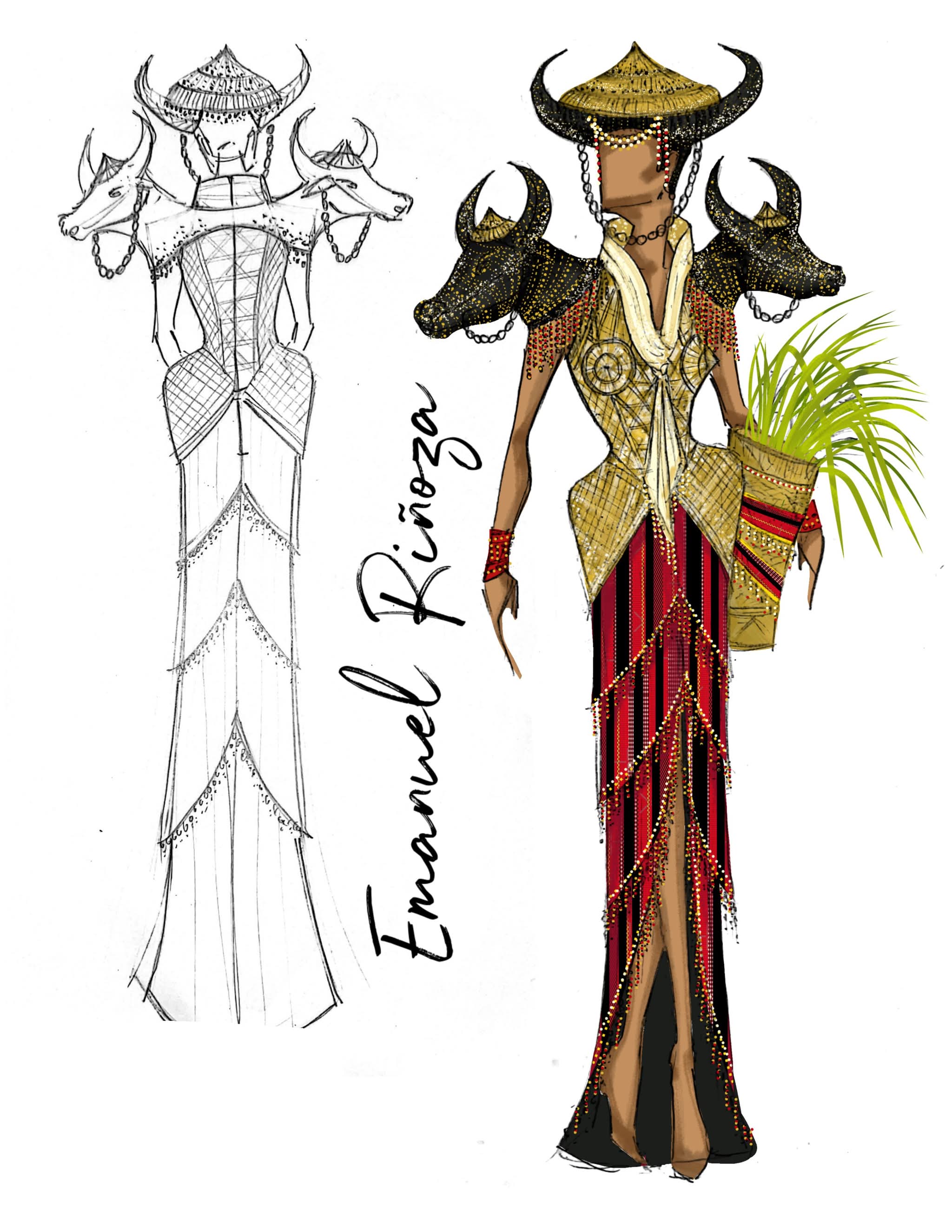
Right at first glance, the look is a study in precise, sculptural tailoring and maximalist detailing. Structured into two parts, the ensemble features a drop-waist corset with dramatic hips that contour Tarah’s silhouette. A conical bust and upright collar frame the upper body, lending an air of regality to the ensemble.
Click to Enlarge
Click to Enlarge
Click to Enlarge
Click to Enlarge
PHOTOS: SEVEN BARRETTO VIA INSTAGRAM/EMANUELRINOZA
In an exclusive interview with Preview, Emanuel shared that he experimented with the solihiya weaving technique—traditionally done with rattan—by adapting it into fabric for the first time.
“It’s my first time doing the solihiya weaving technique using fabric,” he shared. He also admitted that while the weaving itself was a challenge, the final phase of construction proved most demanding. “It’s so time-consuming, really! But when you see the end process, [the challenges involved were] worth it,” he lightheartedly quipped.
The making of Tarrah Valencia's "Kalabaw" national costume. PHOTOS: COURTESY OF EMANUEL RIÑOZA.
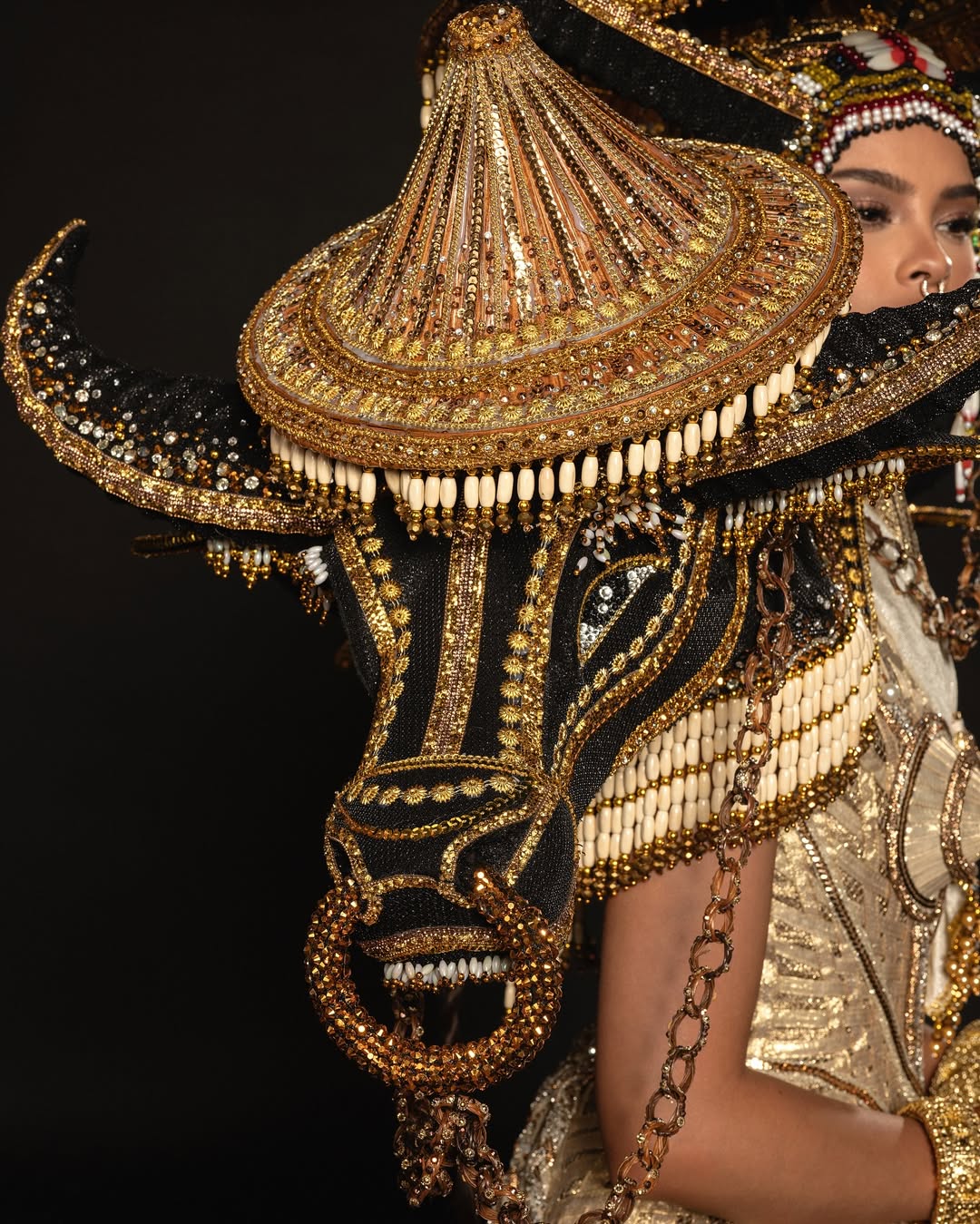
Perhaps the most visually arresting element of the costume are the sculpted carabao heads rising from the shoulders. Embellished with gilded rhinestones and fine linear accents, the surreal shoulder pieces serve as both adornment and symbolism, embodying the fortitude of the working animal.
“I really think it’s the time of the Philippine carabao to shine,” Emanuel said. “They are the unsung heroes of our land—helping Filipino farmers through their daily lives for the nation to feed.”
Click to Enlarge
PHOTO: SEVEN BARRETTO, VIA INSTAGRAM/EMANUELRINOZA.
Further grounding the look in Cordilleran identity, the skirt turns the spotlight on the inabel fabric, a traditional woven textile from the Mountain Province. Rendered into a tiered column silhouette with a front slit, the piece is lavishly embroidered with red, gold, and black sequins and rhinestones.
Impressively, it was Tarah herself who sourced the fabric from the historic Easter Weaving Center in Baguio, which dates back to 1909. “We settled on this very beautiful pattern from the Mountain Province; its patterns are simple but so unique,” Emanuel noted.
Click to Enlarge
The official sketch of the "Kalabaw" national costume. PHOTO: COURTESY OF EMANUEL RIÑOZA.
Completing the ensemble is a reimagined salakot headpiece, an element Emanuel had previously incorporated in a custom look for Mama Pao on Drag Race Philippines Season 3.
Traditionally worn by farmers for protection from sun and rain, Emanuel’s version features exaggerated carabao horns and Cordilleran beadwork all over, referencing Kalinga and Igorot motifs in particular. A ring of beaded tassels trims the rim, adding kinetic detail to its otherwise rigid structure.

Pau is Preview’s go-to fashion girl. On most days, you’ll find her with headphones on, coffee in hand, and likely dressed in an oversized blazer and floor-grazing jeans.