Everything That Happened at BENCH Fashion Week S/S 2026 Day 2
Headlined by industry stalwarts Rhett Eala, Jaggy Glarino, and Joey Samson, the gala night celebrated the 70th anniversary of the relations between Japan and the Philippines.
Published on Apr 20, 2026
Day two of this season’s BENCH Fashion Week took place as its gala evening, staged in partnership with the Embassy of Japan in the Philippines and Japan Foundation Manila. Titled “Thread of Dreams,” the presentation featured collections by three of the country’s leading designers: Rhett Eala, Jaggy Glarino, and Joey Samson.
Each designer explored different facets of Japanese culture, translating these references through their own design perspectives. Silhouettes and structured forms associated with Japan were reinterpreted using Filipino textiles and indigenous weaves, highlighting the ongoing exchange between the two cultures.
“For us, fashion is never only about clothing. It is about identity, national, and personal,” says Ben Chan, founder of BENCH and Suyen Corporation, during his opening remarks.
“Our advocacy of the Philippine terno through education, competition, exhibition, and publication has always been guided by this brief. And through it, we have seen how culture deepens when it is shared, and how tradition becomes more meaningful when it is dialogued with others.”
Ahead, take a closer look at the evening’s presentations, from backstage glimpses to the view from the front row.
Rhett Eala's "Inherited Stories"
The evening opened with Rhett Eala’s presentation, “Inherited Stories.” The collection traces its roots to his mother, artist Roceli “Baby” Valencia, whose early fascination with Japanese culture informed the designer’s own creative perspective. Through the collection, Rhett pieced together a tribute to the imagery that nurtured his artistic sensibilities during childhood. “It’s also about the things that she collected throughout her travels in Japan,” Rhett shared in a video.
Through mementos, photographs, and stories, Japanese culture left a lasting imprint on his worldview—one he now translates into a body of work that invites audiences into a richly layered universe.
On the runway, Rhett expertly treads the balance between movement and sculptural construction. Teacup minis, origami-inspired floral appliqués, and cocoon silhouettes appeared alongside fluid elements: fringe-laden pieces, glistening sequined skirts, and spliced hems that widened and shifted with each step.
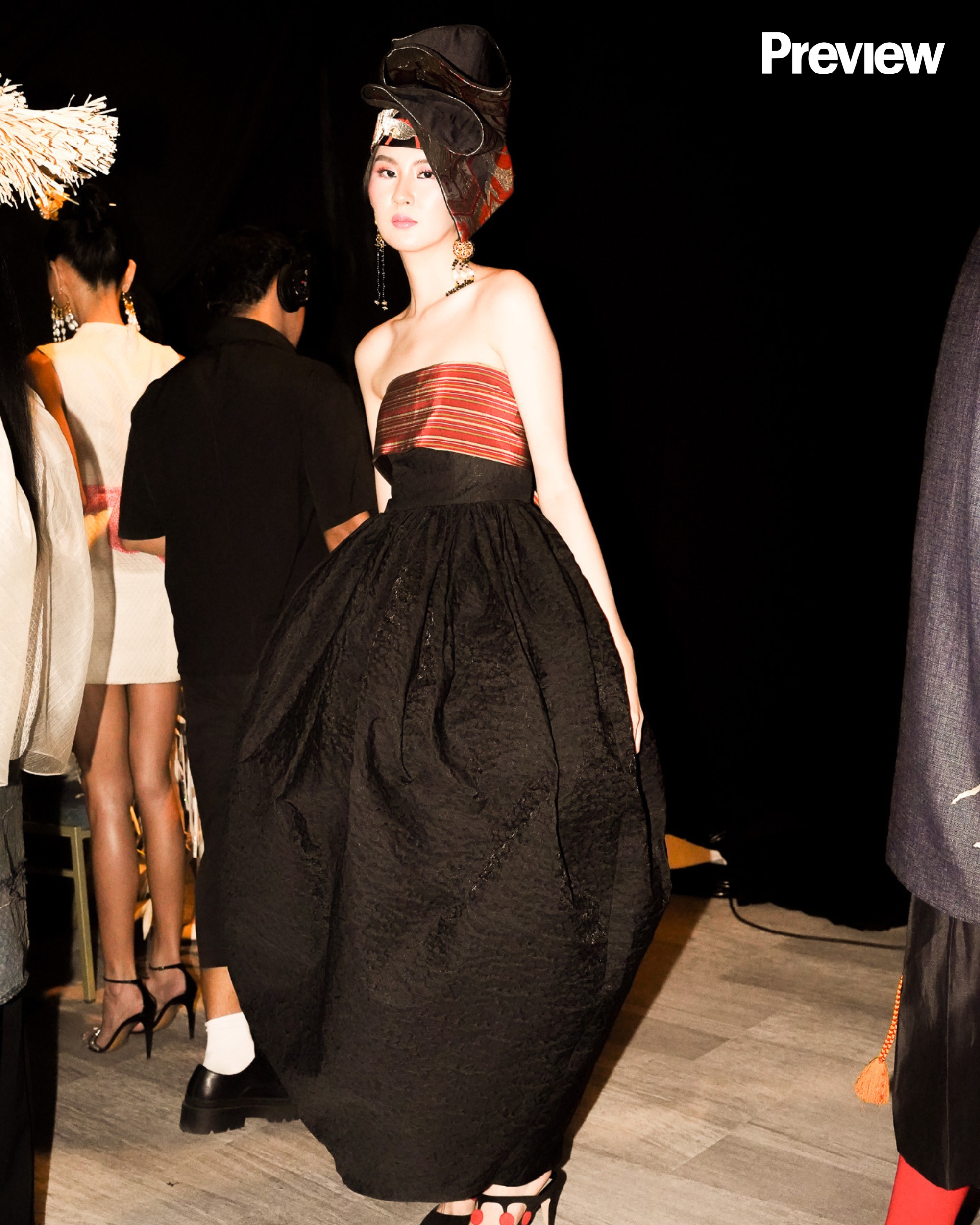
An overarching sense of glamour and femininity ran through the lineup, driven by voluminous proportions and a seamless interplay of Filipino and Japanese textiles.
One look of particular interest featured an enlarged camisa bolero with long, diaphanous bell sleeves, echoing the drape of a kimono. Paired with tailored black trousers and a “saya” (overskirt) crafted from Japanese boro, the ensemble distilled the dialogue between both cultures—a theme that Rhett so deftly captured across the collection.
.jpg?format=original)
Jaggy Glarino's "IMIN"
Jaggy Glarino returns to BENCH Fashion Week for a second consecutive season. Titled “IMIN”—Japanese for “immigrant”—the 2025 Best Filipino Fashion Designer (BFFD) honoree draws from the idea of cross-cultural exchange between Japanese settlers and Indigenous communities in Mindanao.
For this collection, Jaggy looks to Davao, where Japanese farmers migrated in the early 20th century and eventually established communities.
“What stayed with me was how some of them married into local tribes like the Bagobo,” Jaggy narrated through a video interview with BENCH. “It felt very human and very lived. So [the collection] is about the tension, the overlaps, and in-between, and how that translates into something beautiful through fashion."
From the opening look, Jaggy immediately sets the tone for what becomes a visually arresting presentation. A model steps onto the runway in an oversized jacket rendered in his signature solihiya pattern, paired with a supersized banana-shaped backpack. On foot, the model balances the weight of the ensemble atop a pair of geta—traditional Japanese wooden sandals with a single elevated base. In one striking image, Jaggy’s avant-garde language and urban edge come into focus, signaling a distinct shift in direction.
.jpg?format=original)
As the show progresses, the lineup moves through a vivid interplay of color, surface, and pattern. Maximalism courses through the very veins of the collection, with Jaggy and stylist, Creative 25 honoree Roko Arceo, fully leaning into its visual intensity.
An abundance of hues, prints, and tactile elements brings the collection to life.
With Mindanao’s regional weaves placed front and center, the garments bring indigenous dress systems into conversation with precise Japanese construction. References to geisha and samurai attire surface throughout, translated through a mix of local textiles and accented with traditional Japanese fabrics and accessories.
.jpg?format=original)
Armor-like silhouettes emerged as a recurring element. A draped, cape-like long-sleeved top in plaid, for instance, draws from Bagobo warrior dress—typically defined by a short, close-fitting jacket worn open at the front and paired with fitted trunks. Jaggy reimagines its structure in saturated color, leaning into a vivid palette that reinforces the collection’s visual intensity.
Joey Samson's "Imagined Dialogues: Una Bulaqueña & O Sei-San"
Titled “Imagined Dialogues,” Joey Samson envisions a fictional exchange between Una Bulaqueña—the subject of Juan Luna’s iconic 1895 painting—and O Sei San, a Japanese woman whom Jose Rizal encountered in Yokohama in early 1888.
With these two figures as reference points, the Cavite-born designer stages a sartorial inquiry into cultural intersections, conjuring an imagined convergence between the two 19th-century muses.
A “garment surgeon” in every sense, Joey dissects and reframes the anatomy of tailoring: inner shirts are layered over blazers, lapels are deliberately cut on a slant, and trench coats are assembled from panels of artisanal textiles and suiting fabrics.
This approach to deconstruction does not strip tailoring of its precision or complexity. Rather, it underscores the discipline’s rigor. Across dresses, jackets, and inner layers, structure remains at the fore—an exacting finish that speaks to the technical mastery of Joey’s work.
.jpg?format=original)
The collection’s accessories were equally worthy of praise. Select looks were paired with woven bags shaped like onigiri and randoseru (traditional Japanese backpacks), crafted using traditional basketry techniques, alongside oversized wagasa umbrellas.
In more ways than one, by drawing from an imagined exchange between Una Bulaqueña and O Sei San, Joey Samson effectively forged a distinct visual language for this collection—one that is fresh and forward-looking, yet timeless all at once.
.jpg?format=original)

Pau is Preview’s go-to fashion girl. On most days, you’ll find her with coffee in hand, and dressed in an oversized blazer with floor-grazing jeans.