When Did “Mukhang Nanay” Become an Insult?
A mom’s “inappropriate” outfit at her son’s recognition sparked debate. But let’s be honest: the issue isn’t what she wore, but your idea of what a “good mom” should look like.

by Kyla Villena
Published on Apr 1, 2026
A video meant to be about strength has turned into one about shame—thanks to the internet and the misogynistic culture that surrounds us.
Last March 25, toward the end of Women's Month, content creator Joy Basa posted a reel from her son’s recognition ceremony. The clips showed her accompanying her child on the momentous occasion, from walking towards the stage to accepting his certificate and his awards.
On Facebook, the video has garnered more than 255,000 reactions, and on TikTok, over 24.2 million views.
The post was accompanied by the text, “I stood alone at my son’s graduation and still felt proud,” and rightfully so. Providing your child with the right to education as a single parent—in this economy—is truly something worth honoring.
Despite this, many flocked to the comments section to weigh in on her outfit. As seen in the video, Joy wore a strapless velvet corset paired with a pleated maxi skirt. She completed the look with triangle heels and a shell-shaped clutch, keeping the overall palette neutral.
“Main character,” “attention-seeker,” and “indecent” were some of the labels thrown at her. Many were asking if she was headed to a “prom,” “party” or “gala night” instead of her son’s recognition rites. They claimed that the look did not match the formality and solemnity of the occasion, and that her sartorial choice showed a lack of “common sense” and “etiquette.”
Others, however, sympathized with her. “When my baby girl graduates, I’m going to wear that kind of outfit too,” a netizen wrote. “It’s my child’s special day, but it’s also mine—I worked hard to get her there.”
Joy acknowledged the comments and clarified, “This video was never about my outfit. It was about a mom who showed up, stood alone, and felt proud of her child.”
First, let's talk about the dress code.
A recognition ceremony centers on acknowledging students’ achievements, albeit on a smaller scale than a graduation. Still, the principle remains: these are institutional events that call for a level of respect, and dressing appropriately is often seen as the baseline for both students and guests.
Typically, parents are expected to follow a smart casual to semi-formal dress code. Blazers, collared shirts, chinos, and slacks are considered standard. For women, modest blouses, tailored pantsuits, and skirts or dresses that fall at or below the knee are commonly deemed appropriate. Footwear is usually kept polished as well—elevated styles over sneakers or slippers—to maintain a refined overall appearance.
In Joy’s case, part of the backlash seems rooted in the assumption that her outfit was disrespectful to school norms. But the reality is, we don’t actually know what those rules are. While there are general expectations, they are not universal. The Philippines may lean conservative, but institutions still have the autonomy to define their own dress codes—and those boundaries are not always as fixed as people assume.
A closer look at the viral reel shows that Joy wasn’t the only one revealing some skin. Other adults in attendance wore one-shoulder dresses and skirts that fell well above the knee. If the concern were truly about preserving the formality of the occasion, then the same scrutiny should extend to guests who showed up in shirts and skinny jeans—but it doesn’t.
Celebrity stylist Eldzs Mejia also weighed in on Threads, offering a more measured take in Joy's defense. “The look is so modest. There’s barely any cleavage. She’s in a neutral color. As far as I can see, she’s not wearing a lot of makeup and her hairstyle is simple, even though the event is asking for her to go [for] more,” he wrote.
This isn’t new. Years ago, veteran singer and actress Geneva Cruz faced a similar wave of criticism—this time, for wearing a two-piece swimsuit at the beach, a setting where such attire is entirely appropriate. And yet, she was still shamed.

“I don’t care what you think of me,” she wrote, highlighting that women should embrace their style. “No one should be shamed for wearing proper swimwear.”
There seems to be a deeper issue underpinning the intensity of these reactions—particularly regarding how mothers are expected to present themselves. Eldzs’ post about Joy points to this directly. He concluded, “Maganda lang siya kaya naloloka kayo,” and added, “Kasi gusto niyo naka-daster ‘pag nanay.”
Now, let's redefine what it means to be “mukhang nanay.”
I am not a mother, so I have yet to fully understand—blood, sweat, and tears—what it means to be one. My understanding, and perhaps that of my fellow Gen Zs and even Gen Alphas, is shaped by the people around us.
My introduction to beauty as a child came from my mother and the maternal figures I was fortunate to grow up with. I found myself drawn to observing other women—how they comb their hair, look in the mirror, and assess what they see. “Mukha na akong nanay,” said in a disappointed and worried tone, became a familiar song. I must admit that it was one I never liked hearing.
What was not beautiful about the face of selflessness, unconditional love, and hard work?
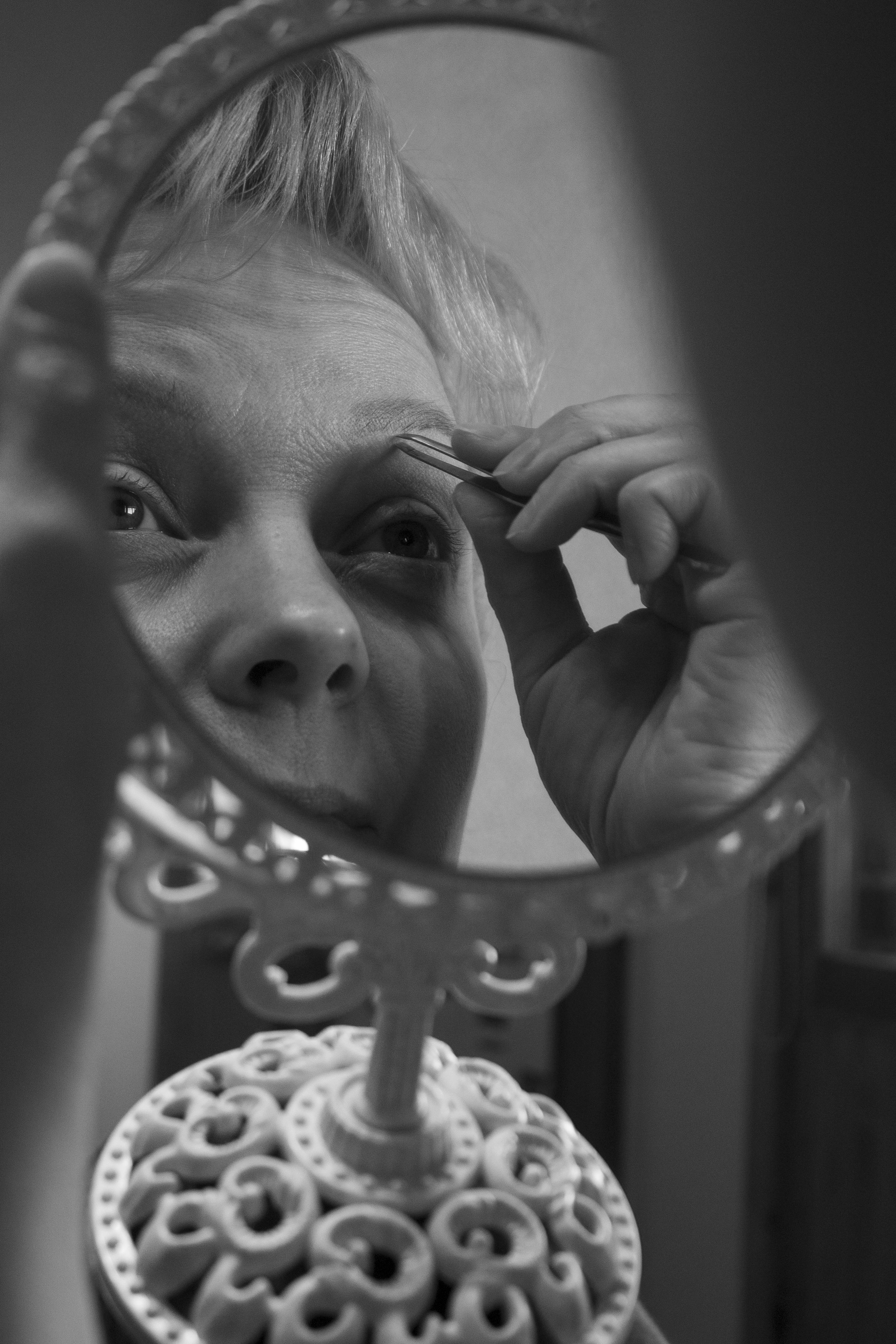
What, exactly, becomes the common denominator when someone is said to “look like a mother”? The image that often comes to mind is one of dull, tired skin—“haggard,” as we often call it. Her hair is imagined slightly tangled, not for lack of care, but for lack of time. Because time, for mothers, is always of the essence.
Our moms are expected to take care of everything: the food on the table, the laundry in the bins, and our packed lunch before the school bus arrives. At the same time, she is expected to take care of herself, too—but ironically, only to a point that she does not “upstage” anyone.
She must appear put-together, but never indulgent. Flawless, glowing skin—but no visible effort. No gray hair, no wrinkles—neither on her clothes nor on her face. No matter how exhausted she is, she must remain pleasant. Always smiling. Always available. Always ready.
Once she begins to “look like a mother,” a new fear is imposed—that she is now replaceable by someone younger. Her children might feel embarrassed to be seen with her; she risks being reduced to a version of herself that society has already decided is past its prime. They'll likely say, “Sayang, napabayaan niya ang sarili niya,” disguised as concern.
Curiously, society doesn’t react the same way when a woman looks or dresses like a tita. In fact, some might even find her appealing. The tita exists in that in-between space—no longer a girl, but not yet fully defined by sacrifice. She is imagined as someone with agency, energy, and the freedom to enjoy herself. A full face of makeup feels appropriate. She has her life together, and she still has room for a little bit of fun.
To be “mukhang nanay,” on the other hand, invites scrutiny. After everything her body has endured, she is expected to cover up—hide behind layers of shame and fabric, stay away from the spotlight, and take up less space. At this stage, she is not supposed to prioritize herself. And so, exerting effort in how she looks or dresses is a sign of unnecessary vanity.
They say that a woman is a woman until she becomes a mother, but I beg to disagree. She remains a woman long after she has borne children of her own, and she can express this in any way she chooses.
I can only hope that someday, when I have children of my own, “looking like a mother” will no longer be treated as an insult. Because it isn’t, and it’s high time we correct it.
Becoming a mother is as difficult as it is divine. I see mothers as sources of love and care, yet we expect them to pour from an empty cup until there’s nothing left to give. Perhaps that’s why society paints them as dull and lifeless. How ironic, considering that all life comes from them.
A woman makes countless sacrifices to become a mother, but her love for herself should not be one of them. I hope to be a nanay someday, and I plan to look the part—but that's something I will define on my own terms.

Kyla Villena loves a good lip gloss and a trip to the art gallery. She is Preview's beauty girl, who doubles as a self-proclaimed motivational speaker.
Read more stories about
team-06526 ,lch-06526 ,preview thinkpiece ,thinkpiece ,op-ed ,motherhood ,dress code ,sc26