What You Should Know About Tattoo Laser Removal, According to Nadine Lustre
The actress opened up about why she decided to erase some of her older tattoos.

by Kyla Villena
Published on Oct 15, 2025
Tattoos are an art form—an expression of self, a way to immortalize significant memories, or simply a means to appreciate an artist’s craft. But while they’re meant to be permanent, they can inevitably fade over time. Such was the case for Nadine Lustre, who often visits the Aivee Clinic to address this particular concern.

Nadine Lustre on Getting Some of Her Tattoos Removed
The 31-year-old actress and entrepreneur entrusts the dermatology and aesthetic clinic for a wide range of procedures, such as the Sweatox to solve excessive sweating, the CyberLift for a more lifted and sculpted look, and the Skin Bionutrition for a youthful glow, to name a few. And as recently revealed, Aivee's Tattoo Laser Removal is also part of the roster.
In a video posted on Dr. Aivee Teo’s Instagram account, Nadine elaborated on her decision to remove some of her tatts. “I noticed that my tattoos are all spreading na,” she shared, pointing out that the inked texts are no longer readable. The edges of some of her tattoos have also feathered out, making them less visually appealing in her eyes. “The goal, really, is to erase all of [the] tattoos that are thick,” she added. Still, Nadine is keeping her distinctive lotus and dragon tattoos—two of her most recent designs rendered in fine lines.

If you’re looking to get a tattoo of your own, Nadine’s advice is simple: “Think about it.” When it comes to how the removal feels, Nadine explained that it’s just as painful as getting a tattoo done.
How Do Tattoo Laser Removals Work?
When getting a tattoo, inks and pigments are injected into the skin. These particles are too big for the immune system to remove, and that’s what makes them permanent. According to the Cleveland Clinic, there are various ways to break these down into smaller particles in order to successfully remove the tattoo.
Laser removal, in particular, involves “focused beams of light directed onto your skin.” It is primarily their heat that helps achieve the ink-free look. Dr. Aivee emphasized that black ink is much easier to target than colored ones, so this is one thing to keep in mind if you’re not entirely sure about the art you’re getting done. Black ink responds well to the treatment because of its ability to absorb light.
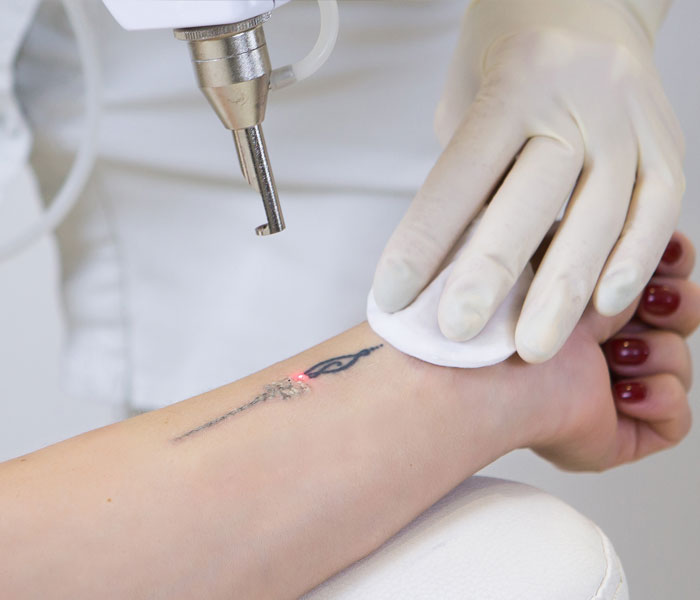
In her caption, the board-certified dermatologist also explained that the process is not one-time. Instead, it is a series of sessions that must be done every four to six weeks, and this assures that the pigment is broken down safely. Tattoo artists apply ink in layers, and so it takes time for lasers to thoroughly break them down.

Kyla Villena loves a good lip gloss and a trip to the art gallery. She is Preview's beauty girl, who doubles as a self-proclaimed motivational speaker.