Francis Libiran Issues Apology Over Inaul Controversy
The designer took responsibility after cultural representatives raised concerns over his portrayal of the traditional Maguindanaon textile.

by Kyla Villena
Published on Sep 8, 2026
Francis Libiran has established a design DNA defined by intricate, bold, and avant-garde creations, often incorporating techniques and textiles rooted in Filipino tradition. However, one of his recent designs drew backlash over the alleged “cultural misappropriation” of the traditional Maguindanaon textile, Inaul.
In a now-deleted post, the renowned Filipino designer shared his latest creation—a “skin-tight” and “high-cut” bustier crafted from the traditional textile. “I didn’t preserve tradition. I weaponized it,” he wrote. He went on to say that he took “the sacred Inaul of Mindanao—handwoven by Maguindanaon royalty—and stripped it of nostalgia.”
Francis described the piece as a “dangerous” interpretation of Filipino heritage, concluding the post with the statement: “Make it modern. Make it LIBIRAN.”
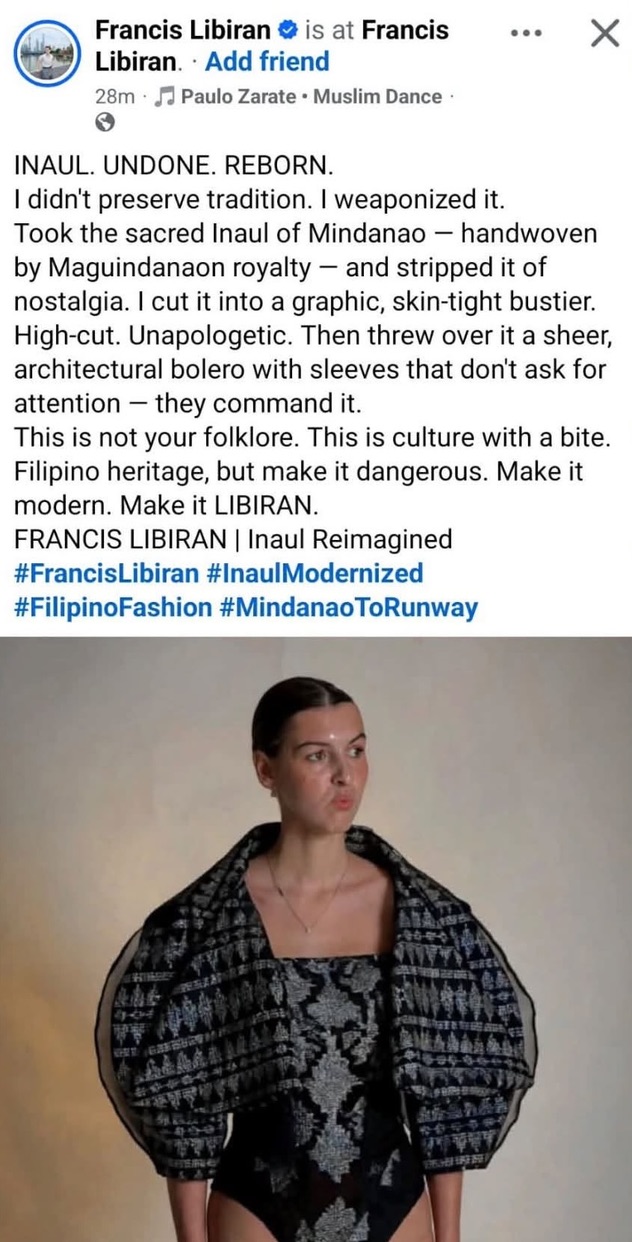
Francis Libiran Addresses the Controversy on His Use of Inaul
On September 2, Al-Nezzar Ali, Head of the National Committee on Visual Arts of the National Commission for Culture and the Arts (NCCA), published a statement addressing what he described as the fashion designer’s “cultural misappropriation” of Inaul. He explained that Inaul carries meanings of “prayer, patience, and lineage,” and argued that “weaponizing” the textile positions the designer as “the one who will save it from its own people by stripping it of nostalgia.”
“What he calls nostalgia is actually reverence,” Ali wrote.
He also challenged the designer’s claim that Inaul is handwoven by royalty, pointing out that it is woven by “ordinary Iranun and Maguindanaon women.” To overlook this, he argued, is to ignore “their present reality.”
Ali also took issue with the body Francis represented, which he characterized as “tall, slim, non-Maguindanaon, non-Muslim.” According to Ali, presenting Inaul on this particular body “declares that body to be the site where Filipino heritage becomes dangerous.” He argued that the textile’s historical “danger” instead lay in “its ability to protect, to signify resistance against colonization and cultural erasure.”
Al-Nezzar Ali acknowledged that Inaul and other traditional handwoven textiles become private property once purchased. In the context of Philippine commerce, he noted that fashion designers may invoke innovation, modernization, and creative freedom in deciding how to use these materials.
However, Ali argued that working with culturally significant textiles also demands an understanding of their context. “A serious designer working with Mindanao weaves knows the cultural grammar,” he wrote. From this perspective, the decision to render Inaul in a daring silhouette carries cultural implications.
“Just because you can cut Inaul into a bikini does not mean you should, if you claim to respect its source,” he continued.
The Bangsamoro Commission for the Preservation of Cultural Heritage in Lanao del Sur (BCPCH-LDS) also issued a statement on September 4, expressing its “concern and disapproval” over Francis Libiran’s portrayal of Inaul.
While the commission recognized the right of artists and designers “to explore contemporary interpretations of traditional materials,” it stressed that “creative freedom should not be used to disregard, trivialize, or sensationalize the cultural identity and significance attached to a heritage tradition.”
The commission further underscored that Inaul is more than a fabric, pattern, or material, describing it as a form of living cultural heritage that embodies generations of traditional knowledge.
On September 8, Francis Libiran responded to the criticism with a public apology, acknowledging both his choice of words and how he treated the textile.
“I used language that was disrespectful to a living cultural heritage that is not mine to redefine. I also failed to present the piece with the cultural understanding and sensitivity that Inaul deserves,” the designer wrote.
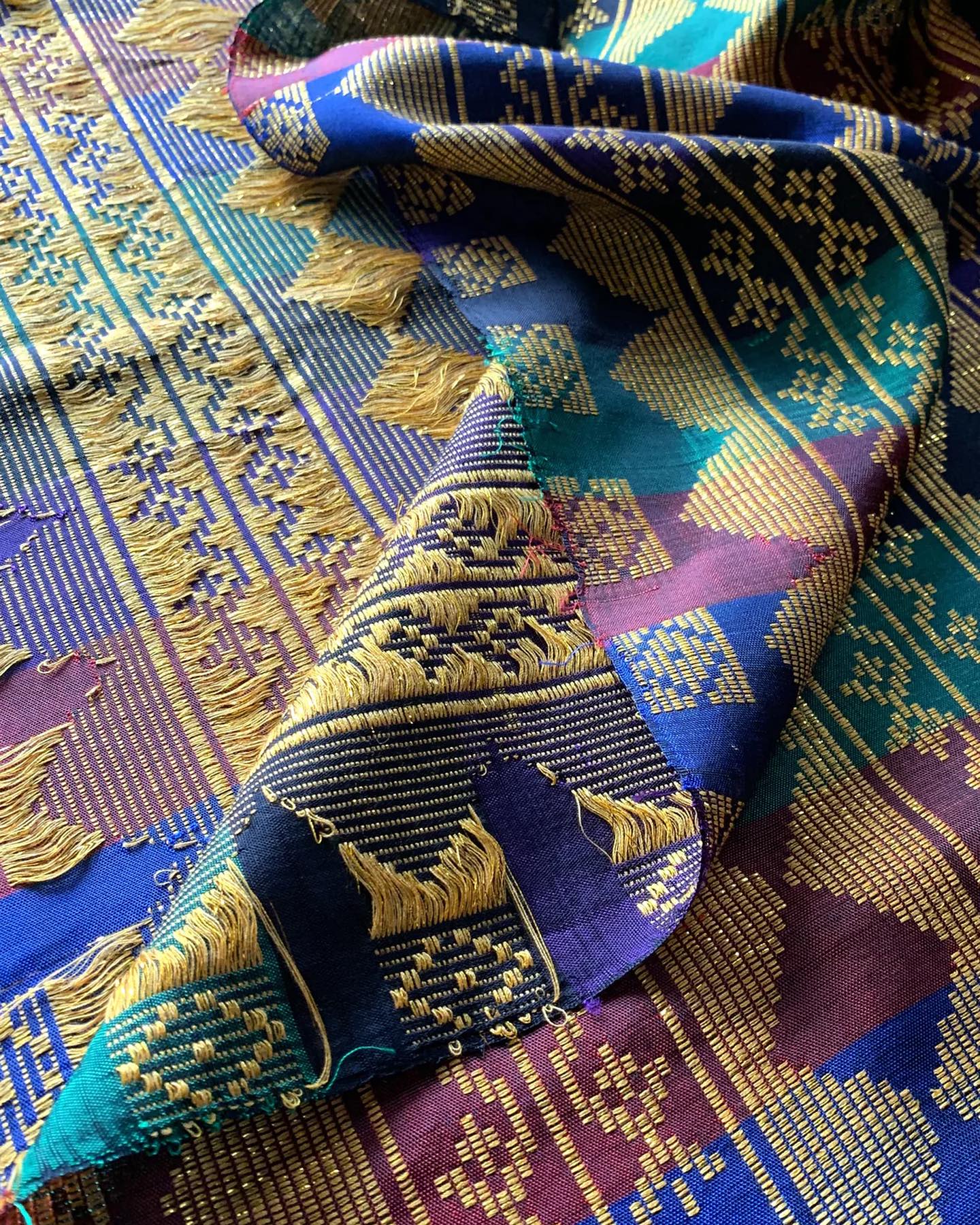
Francis apologized to the Maguindanaon people, took responsibility for his actions, and confirmed that he had removed the original post. He also said he had reached out to the BCPCH and other cultural representatives for guidance.
“I have spent decades advocating for Filipino artistry because I believe our local craftsmanship deserves to be seen, valued, and celebrated around the world,” he wrote. “But I also understand that this purpose must be grounded in respect for the culture and the people behind the traditions I represent.”
Before his public apology, the BCPCH-LDS disclosed that the designer reached out to the commission to personally apologize.

Kyla Villena loves a good lip gloss and a trip to the art gallery. She is Preview's beauty girl, who doubles as a self-proclaimed motivational speaker.